Showing posts with label Alaska. Show all posts

Sunday, June 7, 2015

Summer Bummers

The summer so far in south-central Alaska has been filled with clear skies and hot temperatures, but our cooling winds have brought more harm than good.  There are always pluses and minuses in each area of Alaska when it comes to choosing a place to live or just to visit. There are mountain ranges, elevation, waterways, fault lines, glaciers, mountain passes and road conditions to consider just for starters. Each area of Alaska offers a unique climate, landscape and hazards. 

I consider south-central Alaska to be one of the best places in the state to enjoy spring and early summer weather during the month of May. Before Memorial Day, skies are usually clear and the weather is warm. This year was no exception, hitting 90° and above, making it one of the hottest months in my memory for the area. Other areas of Alaska experienced more of the same with nine towns reporting record temperatures for the month of May. Our northernmost settlement, Barrow, is usually below 30°, but reported temperatures nearing 50°. Good luck to the polar bears. Elsewhere in the Interior, Delta Junction experienced 90° weather in May, then got a shocking, measurable snowstorm which cut power to 360 residents on June 1. Many other towns around the state added May to the books as their top five hottest May on record. To have temperatures hitting 90° this early in the season seems crazy. The village of Eagle reported 91° on May 23 and a week later it was 28°. 

You also have to understand that with a state as large as Alaska, it is unusual to have settlements from Barrow to Annette experiencing record warm weather at the same time. There are so many factors to consider which influence temperatures across the state. South-central Alaska seems to turn green and experience warmer weather quicker than areas farther south in the state. Coastal areas have to consider Ocean currents which may bring colder weather. If you choose an area like Eagle River, you will experience more snowfall in the winter due to the direction of the mountain passage. If you live in Palmer or surrounding areas, dry, windy weather brings respiratory problems. The blowing silt from the glacial bed of the Matanuska River sends extremely high amounts of granite particles into the air, bringing the air-quality way down. Clear blue skies become hazy and white with the granite particles. Residents of the area around the rivers should be wearing some type of respiratory mask, but I never see anyone doing this. I stayed indoors during the worst periods, but I was still experiencing sinus and respiratory problems.
Blowing silt obstructs clear views of Pioneer Peak and surround areas of the Matanuska
River during dry, windy weather.
On the nicer days I retreated to upper elevations, like nearby Hatcher Pass. The subalpine levels still had a little snow and had Spring had just begun. Wildflowers had begun popping up everywhere and I spent my days photographing these tiny bits of color on the mountain slopes. I'm always amazed at the variety of plant life on these sometimes inhospitable mountainsides. I've heard many visitors to the state say how surprised they were at how many flowers we have. They had assumed that with such a cold state, we would have few wildflowers. In actuality, Alaska's mild temperatures and diverse landscapes offer wildflowers the best growing conditions. From a distance, sub-alpine and alpine tundra may look the same, but upon closer inspection you can see thousands of tiny wildflowers of many colors. I spotted about a dozen different wildflowers in one location at the mid-level elevations of Hatcher Pass during the last week of May. All the people below in the Valley may have been wearing shorts and tank tops, the snowy slopes of upper elevations required more clothing.

Upper elevations in Hatcher Pass, June 1st,
Green has only started to appear,


Baneberry blossoms and background Nootka Lupine
 June 1st in the mid-elevations of Hatcher Pass. Plants
are several feet tall.
On May 17, I made a trip up towards the Matanuska Glacier, the green leaves disappearing as I got closer. Once the glacier came into view, most foliage became brown. Just 30 miles away, the seasons were two weeks apart. Areas like this mean you will have one month less of summer a year. That's pretty significant for a state with 3-4 month summers. In the southwest area of the state, Bristol Bay, it was also still cold and brown. Interior areas of the state tend to have larger settlements in valleys, where growing seasons are longer and weather is more stable. Anchorage sits in a kind of sweet spot, with Cook Inlet on one side and the Chugach Range on the other. One main fault of the city is its unstable soil along the inlet, creating a danger of soil liquification during an earthquake. The other huge fault is a lack of space and housing, especially affordable housing. There is no sales tax in Anchorage, and no state tax, leaving the burden to property owners, which makes owning a home in Anchorage a bad investment. At the end of a 30 year mortgage, the home owner will have paid well over the assessed value of the home between the regular mortgage, property taxes and interest. 
A hike along Pinochle Creek trail near the
Matanuska Glacier May 17.
Trees have only just started turning green.

May 12 walk near Palmer. A lot of early green.
For those of us along the glacial rivers and streams, beside the hazards of blowing silt, we also always have the worries of flooding. Warmer temperatures melt the glaciers faster, causing these rivers to swell to dangerous levels. Houses are swept away and roadways shut down. Roads in Alaska are costly and if it's a main highway, like the Glenn, which runs alongside the Matanuska River, it's also a main artery to many Alaska residents. This past year, the Dalton, which is used by the "Ice Road Truckers" to provide necessary supplies to Prudhoe Bay, was shut down due to unusual flooding and thawing and refreezing of the "Sag" River. The delays were very costly and the state had no choice but to declare it a disaster, to receive federal funding for the damages and delays to truckers. In 2014, the Richardson Highway, once again a main artery and the only road into Valdez, was shut down for a long period due to unusually warm weather which caused massive snow melt and avalanches in the Keystone Canyon and the subsequent flooding of the Lowe River. That section of roadway had just been restored from another recent bout with flooding of the same river. 

Even with all of these "inconveniences", I still prefer Alaska to many other states. I may have a slight worry about earthquakes, but you can choose not to live on top of a fault line. There may be flooding, but you can choose not to live in an area which won't wash away. Avalanches happen, but there are precautionary measures to be taken if you and your government are smart enough. The problem is usually our government. Short term solutions and lack of foresight as well as bad spending cause most problems, not the weather. I'm glad I don't have to worry about droughts, tornadoes and major hurricanes. There's just one worry all U.S. citizens share and it's always watching us, telling us how to make our money, spend it and taking half.  It's no wonder people come here to seek a little cabin deep in the wilderness and live off the land. It sounds like paradise to me.

Saturday, January 10, 2015

Fairbanks Fun


In late summer last year, my husband and I decided to spend a week in Fairbanks with my sister. Usually, this week vacation would have been spent in beautiful Valdez, but my dear sibling had moved up to a small cabin deep in the woods outside of the city and there was no way I could resist a week of that. I was not disappointed.

A seat made of rigid foam insulation,
 hanging at the ready in a public
toilet in one of the area parks.
I had previously spent time in North Pole, just outside of Fairbanks. My family enjoyed renting a sod roofed cabin for a week each summer, watching the lazy Chena River slowly flowing by in the back yard. It was almost guaranteed that the week would be gorgeous, with temperatures near 90 degrees. That's a big point for the Fairbanks area, to those wanting sun and warmth in their Alaska vacation. Finding lodging in the area can be expensive, depending on location and luxury, so an RV is a good option for spending more than a day or two. Area campgrounds are peaceful and plentiful and I have also enjoyed tent camping as well as RV camping. Hotels are pricey, but many have blackout curtains to provide a more restful night of sleep in a land where the sun just doesn't quit in the summer. Cabin rentals are available for short or long-term stays. My sister rented her cabin for a couple hundred dollars a month for the spring, summer and fall seasons. This type of accommodation is great for someone who wants to rough it, as they are typically hidden far into the city's surrounding forests and have no plumbing or water. Expect outhouses, in varying states of decay. These types of cabins are usually used by the Forestry Firefighting crews, as these guys tend to be out at fires for long periods of time and are happy to have a base in which to return. 
The steam train runs around the perimeter of Pioneer Park as the
shadows grow longer on a beautiful August evening.
A visit to the Santa Claus House and its reindeer was a must, though my parents never once led us kids to believe in the jolly old fat man. I was that one kid in school who didn't have any problem telling classmates that the man in the red suit who they caught placing presents under the tree was their father. It was still exciting to visit the colorful building, where it's always Christmas. You don't have to believe in Santa to enjoy all the decorations and gifts. Tour buses make frequent stops at this giant gift shop, so it can be crowded at times. There are gifts for everyone in every budget, and no one can resist a souvenir from the Santa Claus House in North Pole. Expect to spend an hour or two exploring the complex. It's a lovely location for a picnic, as there are peaceful spots outside with gorgeous views of the Chena and reindeer.
One of Santa's reindeer in North Pole.
The Santa Claus House in North Pole, with one of its murals taken from old issues of Harper's Magazine.
A peaceful day on the river behind Santa Claus House.
Another spot I always visit is Pioneer Park, inside Fairbanks along Airport Way. This is a 44-acre historical state park with free admission. Various events are held inside, and there is a nightly salmon bake, arts center, small restaurants, museums, mini golf and historical buildings. A walk around is always worth it and I've never resisted touring the free Pioneer museum with its amazing dioramas of typical Fairbanks mining history. Tour the large sternwheeler, Nenana II, take a whimsical ride on the small train around the park perimeter and picnic in the park or along the pond. It's dog-friendly with several dog clean-up bag stations. Not everyone visiting is dog-friendly, however, so it's good to keep your furry friends leashed. 
A Kashim in Pioneer Park, part of the
exhibits and Native Museum in Pioneer Park.
It is an example of a sod home,
once used by the Natives of Alaska.
One of the exquisitely detailed scenes from the
dioramas in the Pioneer Museum of Pioneer Park.

My husband poses next to the beautifully carved
mechanical salmon near the Salmon Bake in Pioneer Park.
A fire scar near Chena Hot Springs. Forestry fire-
fighters from Fairbanks worked quickly to stop this
forest fire from spreading to the Resort and homes.


A panorama of some of the shops and museums in Pioneer Park.

There are a couple of tourist trap type of locations: a tour of a working gold mine with a short train ride and its affiliation, a large riverboat which travels to a native village. The gold mine tour ends with the ability to pan for your own gold in a sluice. Everyone finds about $10 in gold. A lot of people have enjoyed both activities, though I opted to pan the old-fashioned way. We traveled up to the Fox area, where we found Pedro Creek. The creek was panned by Felix Pedro, an Italian who put Fairbanks on the map when he discovered the creek's hidden riches of gold. We chose to follow in his footsteps and spend a day enjoying the cool water and warm weather while painstakingly swirling mounds of dirt in our pans. We didn't strike it rich, but we had a lot of fun.

A close-up of a mechanical salmon, something I can imagine must be quite a
source of amusement after the guests at the evening Salmon Bake have enjoyed a few libations.
A tribute to Felix Pedro. There is more information about his life at the Pioneer Museum at Pioneer Park. 
My sister plays with her husky in Pedro Creek, her gold pan
temporarily resting while the dog frolics in the cool stream.

I had never visited Chena Hot Springs, so my sister decided it would be a fun trip to take in the evening. It's about 60 miles north of Fairbanks and we chose to go in the evening for better chances at  spotting wildlife. We spotted a couple moose and a fox on the ride back. There are plenty of areas to explore along the way, including great hiking trails and fishing opportunities. I did not partake in the hot springs experience, but I enjoyed touring the grounds. The gardens are beautiful and there are numerous pieces of antique mining equipment incorporated into the designs. The reviews of the restaurant are fantastic and they grown their own produce in greenhouses heated geo-thermally. There  is an indoor heated pool for the family, indoor hot tubs and an outdoor hot springs rock pool for those 18 and over. The resort also has shuttle service for those flying into Fairbanks. A trip to the hot springs during Fairbanks' bitter winter is something I can only imagine to be heavenly, with the aurora dancing vividly above the rock pool. 

A metal dragon sculpture seemingly breathes fire as the late evening clouds cross the northern sky.
 It is around 11 pm in August at Chena Hot Springs.
A dog lounges comfortably upon a table outside an Artist Studio in Pioneer Park

A hot springs filtration pond at Chena Resort.

The Fairbanks area has enough activities to keep someone busy and my husband and I were active from early morning to evening, thoroughly enjoying our stay. Though much of our enjoyment came from just relaxing with my sister at her little cabin in the woods, the area provided us with a lot of fun and sunshine and I plan on exploring the surrounding areas further. In fact, we began considering a move to the area, as long as we can stay in the woods outside of the city with my sister. Anyone else who may be interested in a move to this northern metropolis should consider how many residences are without plumbing. There are water stations around town where many residents fill up large tanks to transport home and fill up their own holding tanks. Gym memberships can provide a way to shower each day in the city, or one can brave the laundromat showers. Air quality in the winter is bad, due to the cold weather holding pollution from heating vehicles and wood stoves. Summer doesn't always mean good air quality either, as the thick spruce forests surrounding the city are like tinder boxes. Amazingly long days of bright sunshine also mean frequent lightning strikes and forest fires. Not everyone can brave this climate and its rough and tumble citizens. The Fairbanks residents still seem to live in the rugged past, sometimes making it feel like you've stepped into the old Pioneer days. 
A view of Denali from the outskirts of Fairbanks.


Wednesday, September 10, 2014

Hatcher Pass, Vol. 1

"Falling Apart"
Mine shops along the upper trail around Independence Mine.
I've been enjoying the last of our beautiful summer season in nearby Hatcher Pass. It's a favorite spot for my me and my husband since it's so close and offers a lot of diverse photo opportunities. The lower elevation has the swift-flowing Little Susitna River, mid-elevation levels have a wonderful variety of subalpine plants and the upper elevations are alpine tundra with the Talkeetna Mountains  topped with dramatic rock faces. We almost always see some form of wildlife, be it large or small. There is plenty of parking along the road and numerous trails scattered throughout the 300,000 acres. The pavement ends at the Independence Mine State Historical Park. You can usually continue through to Willow from July to September, if the snow has melted enough to plow, or the snow hasn't yet fallen. The entire area has changing views around every corner, giving a little something for everyone.

At the entrance to the Pass on Palmer Fishhook Road, travelers are greeted by the white rushing water of the Little Su, as called by locals. You can park in the parking lot and get your photos of the river and wander around, but there area also a few more areas along the road where less-often photographed views are available. Some are hidden away with tiny trails and foliage. Please don't stop on the bridge or walk on the bridge for photographs. Pedestrian and vehicle traffic is generally busy here and accidents could easily happen. Gold panning is allowed in many areas, but it's important to check regulations before digging up someone's private claim. A ski and snowboard trail popular with local boarders is at the Fishhook Creek parking lot. In the winter, boarders hitch a ride from this lot, up to the trail's beginning at a large, upper elevation parking lot. Here, they wait their turn for a run back down where they do it all over again. Very busy during the winter with a few rude hitchhiking boarders who get angry when you pass them up. There's a couple of sledding hills that are also packed after a snowfall in the lower elevations.

"Red Edged"
A striking leaf from an unidentified plant in the subalpine level of Hatcher Pass.
Though the area is so close, I've been camping at the two campgrounds available in Hatcher Pass. The first campground, Palmer side, is Government Peak. It has one handicap parking spot for campers and the site for the Government Peak Campground says there are 8 camping sites, though I could swear there are more like 6. I think they are including the day use spots that require you to park in the lot and walk in for a tent site. The fees for the campgrounds are $10. They have outhouses and dumpsters which are bear-proofed. Good thing, since a black bear seems to have been hanging out in that area this summer. It killed a moose in the adjacent ski trail parking lot in early summer and I saw a large black bear foraging berries on the slope nearby in late August.

"Chef's Quarters"
Tim, my little Chef, stands reflecting on the balcony of the Cooks' Quarters at Independence Mine.
Traveling up past the Gold Mint Trail takes you to some breathtaking views of the Palmer area while suddenly climbing in elevation. The Archangel Road is a bumpy, terribly rough dirt road that I would recommend only be traversed by a good 4x4, bike or by foot in the summer. I have been back with a two-wheel drive truck, but my tires had a near-death experience when crossing a rusty culvert with jagged edges protruding. There's another day use parking lot with a trailhead and outhouses further along. This is a good trail to start searching for subalpine wildflowers if you are interested in wildflower identification or macro photography. There are also a number of cheerful birds in this area which might interest the wandering birder. The area becomes ripe with blueberries in late August.

"Rough Riding"
The Archangel Road when I last traveled that mess.
Independence Mine wraps up the paved portion of the Willow-Fishhook Road. There's no camping at the Mine and a $5 day use fee applies to anyone staying for over 30 minutes. I would recommend a day for exploring the area. There's a lot to see, especially if you decide to visit the Visitor Center, museum or bookstore and possibly engage in a tour for $6. Hiking Trails around the area can provide hours of entertainment, whether viewing pika on nearby boulders or examining the alpine tundra's plethora of miniature plants. There are still private mines and property up here, so respect the boundaries. I noticed a very large number of dog owners like to walk their furry friends around the park trails.

"The Chef's Staircase"
Tim appeases me by posing for my picture in the Escher-like staircase of the Cookhouse at Independence Mine.
I love, love, love dogs, so I do enjoy stopping for a moment and talking with the little guys and offering a quick pet before continuing. I usually never even see the owner because I'm so focused on the dogs. As much as I enjoy this, I did see evidence of some irresponsible ownership. Some people didn't clean up after their dogs along the trails, some let them wander too far on their leash, trampling delicate tundra that is posted as revegetation. On surrounding trails without leash requirements, some dogs wandered well off the trails, bothering the wildlife. One more important factor in letting a dog run loose is the fact that many bear attacks in Alaska occur because someone let their pet run ahead and encounter a bear. The dog ultimately freaks out and runs back to the owner, with the bear on its heels. Many bears are shot because of the irresponsibility of their owners. The barking also got frustrating and it disturbed the many small critters trying their hardest to prepare for winter. Dogs left in the vehicle seemed to all go crazy when their owner walked away.

"Siberian Aster"
A delicate and satin-petaled fading aster in the alpine tundra above Independence Mine along Gold Cord Lake Trail.
Just as frustrating as the irresponsible dog owners were the ill-behaved visitors who disrespected historic artifacts by throwing and playing with some of the objects. I observed group of people swinging on the aerial tram cable. One object had been laying in a meadow and my husband took a picture, which was nice, since on our next hike we discovered the object had been thrown into a beautiful little mossy stream.

"Left Behind"
An artifact Tim photographed, west of the main mine complex, which someone later threw in the creek.
If you have an adequate vehicle for rougher road travel, venture on up to Summit Lake or continue through to Willow. Most rental car companies do not allow travel on the gravel/dirt portions of the road and it can be muddy with jagged rocks. On our last visit, there was a Jeep owners meet-up happening. A 20 or so Jeep caravan passed us on their way over the Pass on the gorgeous September morning. There are more trails on this road and a chance to play in the snow in summer, which I've found appeals to many visitors.

"Dusty Drive"
The gravel portion of the twisting mountain road leading over the Pass toward Willow.
Despite its crowds on the weekends, it's still a fun place to spend the day and I always recommended a trip to the Pass for any Visitors. It's a very popular day-tripping spot for the Anchorage crowds, so I try to avoid weekend visits, when possible. The public restrooms get pretty iffy by the end of the weekend and could use more attention.


Friday, August 22, 2014

Arctic Ground Squirrels


A recent trip to Hatcher Pass once again left me feeling happy and content. My husband and I decided to spend the evening out and although we looked at the sky and saw beautiful clear blues with warm sun all around us, we opted to go in the only direction where clouds covered the mountains. The reason for this was purely wildflowers. We hoped for light rain and saturated colors for our macro shots of the many lovely plants scattered across the different elevations of the Pass. More on that later. A wildflower post of Hatcher Pass will take a while. I'll just say that it was a successful trip, once again. For now, I've put together photos and video taken on our Hatcher Pass hikes of the Arctic Ground Squirrels living in the many burrows along the trails. The video was taken on our August 18th wildflower hike near Independence Mine.


John Muir called the arctic ground squirrels the "staff of life" for the many animals of Denali National Park. These cute little rodents are one of the most common food sources for the predators of Denali. On a trip recently to Denali National Park, I found an interesting ground squirrel display hidden away in the interactive educational displays in the main Visitor Center.


The sign on the display says that one burrow in DNP had 56 different escape exits to avoid digging predators. Hatcher Pass is littered with small holes, a hazard to watch out for while hiking.

Friday, August 1, 2014

Hunting...

Growing up in Alaska with a Father who hunted, meant that I grew up hunting. As the oldest daughter, my Dad was always teaching me how to shoot, fish and hunt. I enjoyed myself, though it wasn't exactly a walk in the park. Hunting and fishing in Alaska can be quite difficult. It can be strenuous, back-breaking, nerve-wracking, dangerous and wet! Then there are the regulations to follow. Alaska's hunting and fishing regulations are very strict and extensive. The troopers who have to patrol this enormous state to catch hunting and fishing law-breakers have a lot of ground to cover. Needless to say, some people get away with breaking the laws of the land. Those who don't, get their equipment, vehicles, boats, ATV's and their game confiscated. Whatever they were using to commit the illegal act is taken, and they are heavily fined. I'm talking about this subject because I feel a lot of non-Alaskans misunderstand Alaska hunters and hunting regulations.

Let's start with food sources available in Alaska. Some of us have a grocery store. Some of us don't. The prices of food in Alaska are pretty high in comparison with other states. In many rural villages across the state it's not possible for the residents to get what they need whenever they need it. The prices are extremely high for them, and they don't usually have much of an income, if any. Some of the prices that may be seen in a rural village grocery store are $14/ half gal. juice, $9/ half gal. milk, $14 for a small container of fruit,  $8/box cereal, $7 loaf of bread and fresh water is very high as well. Then there's the cost of living. It can be hard to get somewhere up here. We don't have mass transit except for some buses in Anchorage. Gas in rural communities can be upwards of $10/gal and the same for heating fuel. There are many villages which don't have access to clean water for drinking and with high prices for anything healthy, their alternative is cheaper juices and sodas which are sugar-filled. This leads to dental and other health problems. The price of medical care in Alaska is higher, too. So when a fishery or land management area is closed to hunting and fishing for people in the area, it's denying them access to the only food source they can get.
Killing it in Valdez. Yeah, I'm an awesome angler, I don't mind saying. I was taught by the best.
 The next people who hunt are those like my family. We have access to grocery stores, but prices are fairly high. Having meat in the freezer for the winter was important. We ate a lot of fish, moose and caribou which we worked hard to acquire. I can say with all confidence that our meat was a lot better than the corn-fed, antibiotic filled meat you find at the store. My father grew up poor, and to save his mother from having one more mouth to feed, he would disappear for days at a time. He would live off the land for a few days and then come home, receiving a scolding from his mother for disappearing so long. He was only about 10 when he started doing this. Naturally, he wanted to show his daughter how to do the same. I grew up feeling like I could withstand any disaster that came, because I can wander off into the woods and live just fine. We didn't hunt for sport. 

It's easy to tell who is hunting for sport and who is hunting for necessity. Anyone spending thousands of dollars on gear and guides and planes is out for the trophy. I hear people talk badly of Alaskans for hunting this way, but in reality, it's people from out of state flying up here for the thrill of the hunt. Lucky for them, we have a lot of wildlife and not a lot of Alaskans to hunt them. I read the state trooper dispatches during hunting and fishing seasons and I see a lot of people from out of state getting the fines. Commercial fishermen and game guides come up here to partake in Alaska's bountiful harvests, and then take their money out of state to spend it. Personally, I think if you're going to benefit commercially from Alaska's wildlife harvests, you should have to live here. Plenty of the guides from out of state don't obey our laws, either. At least when these law-breakers are caught, their harvests are confiscated and donated to charity.

One major thing that has always bothered me was the people from out of state that don't know enough about Alaska's wildlife regulations to pass judgement, yet doing so anyway. I've been attacked verbally by narrow-minded individuals that have no concept of subsistence or survival in Alaska. In fact, I've felt offended many, many times by ignorant comments about Alaska and Alaskans. There are organizations that have an agenda and spread slander or propaganda defaming Alaskans and the Alaskan way of life. Most true Alaskans are wary of "outsiders" and feel on edge when engaging in conversation. We're just waiting for the topic of hunting, gun control or Alaska government to come up and we have to play defense constantly.

A successful caribou hunt for me. A good hunter dresses the animal in the field and bags it in game bags to keep flies off. Preserving the meat is of the utmost importance.
Since I was a young teen, I've had to defend myself from people operating on emotion. I engaged in debates during school, always taking the side of the hunter, since these are the topics for Alaskan schoolchildren. When arriving for the first day of school, kids swapped hunting stories. I was left out, because I was a girl. The boys and even teachers looked at me like I was speaking a different language, just because I could say what type of gun I used and the game district where I hunted. For me, it was even more difficult to feel accepted. Then when I moved to Maryland for a short period of time, I nearly had a nervous breakdown. The negativity of people towards Alaska and its people was overwhelming. The culture shock was hard enough, but to have people blasting your way of life and the land you love without knowing any of the facts was unbearable.

We are not a bunch of cruel animal killers. We do not let people get away with shooting whatever they want. We care about our wildlife and have strict hunting and fishing regulations. You have to apply for a caribou permit for specific herds, and hope you get one. If you want to get a cow moose, you have to apply for that and be lucky as well. You can get a hunting permit for bear or bull moose, but the regulations for jurisdiction, size, age and antler specifications makes it a very difficult hunt. That's why trophy hunters hire guides to tell them when to pull the trigger.

I don't hunt anymore, and I fish for salmon when I can. Hunting was an experience I won't ever forget. It was scary, adrenaline-pumping and exhausting. I stopped when I began having dreams of moose pulling a gun on me. We don't all enjoy killing an animal, I know I had issues with it. However, if I end up living in the bush and taking up a subsistence lifestyle, I would do it again when necessary. I could survive and provide for myself in the wilderness. How many women can say that?


Saturday, July 12, 2014

Surprisingly Colorful

Some of the most frequent questions I received while working at a Visitors' Center were about the flora of the state. A lot of people didn't expect Alaska to be so full of colorful plant varieties. In truth, we can support a wide range of plant life and there are plenty of wildflowers across the state. We even have problems with invasive plant species taking over critical habitat areas and killing the native plants which are important to the wildlife. A large part of this problem is from the seed mixtures construction companies use along highways when re-seeding new road sections. Another part of the problem are the large "box" stores we have up here now. In the summer, these stores get shipments of plants which aren't native, but do quite well in our climate. The birds end up spreading seeds along riverbanks, which carry the plant material downstream and eventually we end up with important waterways being overrun by plants which aren't great for our wildlife or native plant life. It's sad to see less and less of our beautiful fireweed or lupine along the roads.

Alaskans tend to get pretty excited when presented with a new plant choice. Even I filled my garden with non-native plants at one time. Alaska is behind the times with a lot of things, and one of the biggest things is shopping. When I was a kid, my family had to drive into Anchorage for shopping. Once a month, we'd unwillingly pile in the car for the long ride to the "big" city. We got almost all of our food, clothes and essentials from Anchorage. Now, I get into Anchorage once every year or two, if I must. Suddenly, big box stores began popping up in Anchorage, and then closer to home. It was a big deal to finally be able to shop at these places. New merchandise and a wider variety of choices was a thrill to many Alaskans. I've heard people scream with excitement when hearing we'll be getting a new restaurant or store chain. Most people living here are not born and bred Alaskans like I am. They are transplants from states like California, Texas and Maryland. Those are the top three states from which "Alaskans" now hail. My parents came from Maryland before I was born, thank goodness, but I met my husband there. After getting married, it didn't take much to convince him we needed to live in Alaska, and he's never gone back. Along with many of these "transplants" come their desires for a bit of "home." A store or restaurant which they may have frequented in their home state is like getting a piece of home back.

Unfortunately, not all of what these stores bring from other states is good for our own beautiful and wild land. A person sees a cherry tree and they don't just see a plant, they see a part of their past. Nostalgia sells in Alaska. Extremely well. Gardens become full of plants which grew in a person's home state. While trying to re-create the past, people are unwittingly destroying Alaska's present. We need more people to start appreciating what Alaska has to offer. There are plenty of beautiful native plant species, but the popular big stores don't sell them. It has become an epidemic and the struggle to keep invasive plants under control is getting harder. Soon, all of the flowers a visitor may see on the roadside will no longer be Alaskan wildflowers. I have become very interested in documenting Alaska's wildflowers with photography. When I started taking pictures of flowers, it was a way to identify Alaska's plants. Now it may be the only way to preserve them.
Some of the beautiful wildflowers I've come across during camping trips around the state.
Names and descriptions of many wildflowers can be seen on my Flickr page here.

Thursday, July 10, 2014

Before Booking

Making the trip to Alaska is a big deal. The cost is considerable and it's very, very important to do your research before booking anything. There are different options available for everyone, whether you have a lot of money or a little. A little planning and internet digging can save you a lot of time, money and frustration so you can get the vacation you want.

The Whole Package
Those who want to sit back and relax while enjoying some of Alaska's most thrilling sights usually opt for the cruise. There are cruises that depart from Washington state and make their way up the Inside Passage, finally landing in the small town of Seward, Alaska. From Seward, it's possible to continue to Anchorage by way of the Alaska Railroad, an incredibly scenic journey around more glaciers and wildlife. The cost of the trip can be more expensive when booking during peak season rates, which are mid June through July. If you want to really go all out, keep riding the train up to Denali or even Fairbanks. You can book a couple of nights in Denali and take a bus ride into the park for the day. Lodging can be booked either at one of the lodges at the end of the Denali Park Road or just outside the Park at one of the hotels. Expect pricey lodging, especially during peak season in Denali. The cheaper the lodging, the quicker it's going to fill up, so if you are on a budget it's important to plan at least a year in advance. If you are booking a hotel outside of the park and have taken the train, find a hotel that offers shuttle service to avoid a long walk. "The Whole Package" for a couple could cost $5000 to $7000 or more, depending on the time of year and lodging choices. This would also (hopefully) include airfare back home.

The Budget Cruise Package
A lot of people are quite thrilled with just a cruise from Vancouver to Seward, and then flying home out of Anchorage. Hertz car rental is the only major rental agency available out of Seward, catering to cruise-goers when they reach the end of the line. Car rentals aren't cheap in Alaska and may cost $100 or more a day. If you go with a rental, you could take your time in Seward and explore the area, maybe take a walk to Exit Glacier if you didn't get enough of them on your cruise. Exit Glacier is very accessible with a nice trail and the ability to get up close and personal to the mammoth, moving ice river. If you're staying the night, book your hotel early. There isn't much available in Seward for accommodations and if you wait too long, you'll spend a lot for a room. You can also do this trip backwards. Cheaper fares are in May and late August or very early September. Our tourism season starts around May 15th and ends around September 15th. Expect to see snow in more areas if you book early or late in the season.
Exit Glacier outside of Seward
Going Independent
If you're doing all the planning yourself, make sure you read reviews about every place you book. It's nice to have a company do it all for you, but it can be more expensive or even a scam. You are vulnerable when booking online and there are people out there who are all too willing to take your money and run. Fake companies pretend to be selling you a vacation package, only to disappear from the web after receiving your money. Other people buy up reservations a year or more in advance from tourism hotspots like Brooks Falls. They may sell these reservations along with airfare to Katmai National Park for a hefty sum. This is another major reason to book your reservations early!
Those who want to be really independent may want to rent a motorhome and save on hotels. You'll pay for gas and mileage, so make sure you're actually saving money, especially when getting from point A to point B in Alaska can mean hundreds of miles. Also consider the fact that most rental agencies don't allow travel on gravel roads. This limits where you may venture. There are some people out there who privately rent their own personal motorhomes to visitors. You can check Craigslist or Alaskalist for this option. Something that my family did quite often when I was a kid was to fly from Alaska to Maryland and buy a used motorhome. It gave us transportation and a place to sleep and then we drove it back to Alaska and sold it. If you're planning on staying for a month or more, it's certainly an option. You can leave the motorhome behind at a used car lot for them to sell for you, or drive it back home.

Sampling the Fare
It's fun to plan activities that give you an inside look at Alaska life and provide an array of entertainment. Spend a day or two in Anchorage and explore the Anchorage Museum and the Alaska Native Heritage Center. This year the museum is displaying an exhibit on the 1964 quake and you can also visit Earthquake Park for an informative stroll through an area hit hard by the earthquake. Take a ride down to Portage Glacier and stop at the Alaska Wildlife Conservation Center to see animals you may miss on your journey. A trip to Whittier is a hop, skip and a toll away from Portage. Its access is by way of Alaska's only tolled road section, a tunnel which now accommodates vehicles. It was formerly a town only accessible by train. From Whittier you can take a day cruise and see the marine life without driving all the way to Seward. There are many fishing hotspots easily found if you want to try your luck catching salmon, but check all the regulations before casting a line.

Rent a cabin in the wilderness. Cabins can be anything from sparse and rustic to grand and luxurious. There are basic Park Service cabins for the adventurous and they are cheap if you manage to get a reservation. A lot of these cabins require a hike or a boat ride, but there are a few that are easy to reach. You could explore a glacier in whatever way suits you. Matanuska Glacier is located 100 miles north of Anchorage and offers glacier viewing or glacier treks with a local company. Access to the glacier is through a private entrance and a fee is required. If you came for a thrill, check out the rafting on the Matanuska River or a Zipline ride. There are a few lodging options in the area, including cabins.
Matanuska Glacier as seen from campground

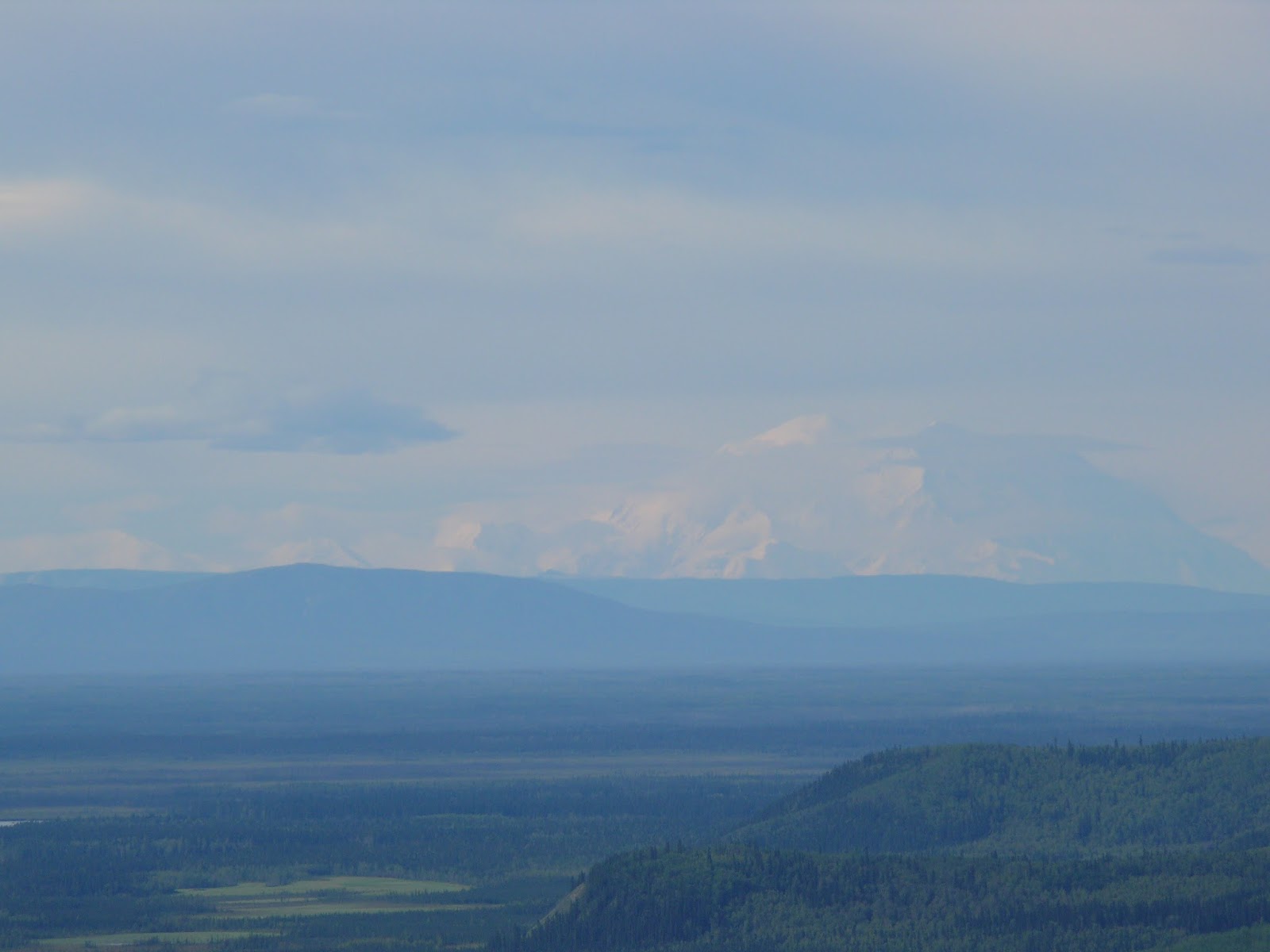
If you don't have the time to drive all the way to Denali National Park, drive up to a small town called Willow or one of the state's viewpoints of the monster mountain. From Anchorage the park is 237 miles, Willow (milepost 69 of the Parks Highway) is 81 mi. away and the state viewpoints begin appearing at Milepost 135 on the Parks Highway. On a clear day you can even see the mountain from Anchorage if you want a glimpse without the longer drive. Earthquake Park can provide one of the glimpses among others in Alaska's largest city. If you want to explore a little more and are able to drive on gravel, take Petersville Road at mile 114.9 of the Parks Highway. It offers spectacular views and a chance to see moose or even bears. Remember that you will only see the mountain if it is clear and sunny. You may have more luck in the morning if the mountain is in a good mood and not making its own storm systems. There are a few dog kennels along the Parks Highway that offer a chance to ride a dogsled and even meet an Iditarod musher.
A slightly shrouded Denali looms in the distance as seen from Willow
If you arrive during the last week of August or the first week of September you can spend a day exploring the Alaska State Fairgrounds and see what the long daylight hours do to our vegetables after the summer growing season. This is where gardeners from all over the state bring their giant veggies to compete for a chance at a Guinness World Record. There are a number of Alaskans who hold world record titles. The fairgrounds are located in Palmer, an hour's drive north of Anchorage.

Roughing It
Alaska is a beautiful place to hike or bike, though it's not exactly easy. I don't consider Alaska to be biker-friendly. Personally, I would love to see more bike paths along the highways and make it safer for people who want that option. There are many areas that pose dangers to bikers or hikers along the road systems. A lot of road sections are quite narrow and winding and offer a biker no protection from passing vehicles. There are also very few hostels for people who are keeping things cheap. The best option for roughing it is to bring a tent. Campgrounds aren't always necessary since there are many places along the highways where other campers have left their marks. You can usually spot a campfire ring of rocks marking a decent place to pitch your tent for free. It might be worth paying a bit of money to take a bus or train to Denali National Park and hiking or biking off the well-traveled road system. There's even a shuttle van and bus that will take you into Wrangell St.-Elias National Park where you can explore Kennicott Mine and Glacier and venture into a wilderness still largely untouched. A bus will take you from Anchorage to Glennallen and a shuttle van will transport you from Glennallen to McCarthy and Kennicott.
A typical campground offers a fire ring, picnic table and outhouse.
The price is usually $12- $15 a night.
If you can get a ride up to the Denali Highway, a supreme scenic journey can be found by crossing from Cantwell to Paxson or vice-versa. Cantwell is on the Parks Highway and Paxson is on the Richardson Highway. Late June to late July is a better time of year for traveling the tundra to avoid the cold winds and snow. Denali Highway is a mostly gravel, 134 mile long road that connects two of the state's major highways. It varies from lowlands to high tundra and is home to abundant wildlife.
A campground along Denali Highway near Paxson.
The small brown building with the green roof is the outhouse facility.
There is so much to see in Alaska and so many ways to see it. The scale of wilderness is hard to fathom unless you see it in person. A common mistake among visitors is their inability to grasp the distances between destinations until they arrive. They also tend to believe that just because they plan on staying in a town there will be lodging available. Always plan ahead for accommodations and read the reviews. Just because a room is $100 a night, it doesn't mean it's comfortable or clean. This is a state where many people still have outhouses and no running water or electricity, so the standard of what makes acceptable sleeping quarters can be a bit dodgy. If you expect a good night's sleep and comfort, check out what other visitors have reported before booking a bed that feels like sleeping on a board. If you're planning on taking a guided tour, either by bus, train, boat or even a guided fishing trip, keep in mind that your guides may not be from Alaska. Companies tend to hire people from out of state and their knowledge of Alaska is pretty much zero except for the script and info given to them by the employer. Since Alaska has such a high minimum wage, young people from out of state jump at the chance to make a little more money. Alaskans would expect to be paid more, and many residents already have summer jobs. Just because you're paying a lot for a tour doesn't mean you're paying an expert. A good number of fishing guides come from out of state as well, and don't stay informed of the rules and regulations. It will cost you your catch and your guide will be fined if caught unknowingly breaking the rules. All illegally obtained fish are confiscated and donated to charity.

Learn more about the state before your visit and check out these sites for more information about some of the activities mentioned.

Shuttle bus tour into Denali:  
http://www.nps.gov/dena/planyourvisit/shuttles.htm

Earthquake Park:                       http://www.muni.org/Departments/parks/Pages/Earthquake%20Park.pdf

Wildlife Conservation Center      
http://www.alaskawildlife.org/

Anchorage Museum                    
http://www.anchoragemuseum.org/

Alaska Native Heritage Center    
http://www.alaskanative.net/

Glennallen to McCarthy Shuttle  
http://www.nps.gov/wrst/planyourvisit/mccarthy-road-transport.htm

Tuesday, December 17, 2013

On to Valdez

Continued from previous post: Missing Valdez

After leaving Keystone Canyon it's a short distance to Valdez. The oil pipeline terminal is located at the end of Dayville Road, before entering the town.  The road follows Valdez Harbor and is a great spot for fishing.  There's another waterfall and Solomon Gulch trail to climb if you aren't scared of the bears. Black bears and coastal brown bears love to fish, too.  The trees are usually filled with bald eagles and the air is pierced by their calls.
One of two dozen bald eagles
spotted at one time at Allison Point.
I am finally seeing wildlife recovery in this area after animals disappeared from the Exxon Valdez oil spill in 1989.  I was a small child when it happened, but I understood the gravity of the situation. Several years after the oil cleanup is when my family started spending time in Valdez. Compared to then, I see a lot more wildlife now. The water is full of steller sea lions and sea otters. Brown bears are starting to show up and bring their cubs.  When the fish are running, you can expect to see any or all of these animals together at once.
Solomon Gulch 
A hydroelectric dam is located along Allison Point. A bridge crosses Solomon Gulch, the freshwater destination for spawning salmon. There is a weir located here along with the Solomon Gulch Hatchery, where you can learn about the salmon and watch as they climb a fish ladder.  Fishing is prohibited near the hatchery and weir.  Posted signs and marked posts show where the fishing boundaries lie. You can buy fishing licenses in Valdez at bait shops or the grocery store. There are also services for fish packing and shipping. 
My husband's catch of pink
salmon for the day at Allison Point.
Valdez was originally in a slightly different location before the 1964 earthquake. When the 9.2 momentum magnitude quake hit 45 miles west of Valdez, tons of land slid into the harbor.  Thirty-one people died, most of them being children. Streets and docks were destroyed along with many buildings. The army corps of engineers decided it was necessary to relocate the town to more stable ground. Sixty-two buildings were moved and a new townsite was constructed. You can visit the restored gold rush cemetery that was used between 1898 and 1917. An informational sign can be found just off the Richardson Highway, along the gravel road leading to the cemetery. A visit to the downtown Valdez Museum can offer more information about the earthquake and I've heard it's well worth it. I plan on going as well, just as soon as I stop spending all of my time in Valdez fishing. There is also the Whitney Museum, which has an extensive collection of Native artifacts, located at the Prince William Sound Community College downtown. 
Prince William Sound Community College
The docks are fun to explore and there's usually a salmon and halibut derby running, so anglers crowd the fish cleaning and weigh-in stations for a chance to claim the winning catch.  There is a visitor center at the edge of town, with a nature trail and views of spawning salmon. I have seen black bears crossing the road and trail here on numerous occasions as they come down from the waterfall-streaked mountain and head for the beach. Always be bear-aware around Valdez. 
A costal brown bear subadult eats grass,
patiently awaiting a tide full of salmon.
Though the town is so small, it's big on character and charm. I never find enough time to do everything when I'm there, since I have to plan my schedule around the tides. You can also fish at the dock in town instead of Allison Point. I caught a lot of ling cod there in the past. I could put my 3-hook pixie in the water and seconds later had a fish on each hook.
Valdez Boat Harbor
Whether you go to Valdez for the fishing or the views, you'll have a great time. Make sure to take your time and explore. It's important to also know the history of many Alaskan towns to appreciate the hard work and sacrifice it took to settle in the Last Frontier.  While traveling the Richardson Highway, think about the Athabascan Natives who originally traversed this harsh land, creating the important trails we now use as roadways. Remember the many prospectors who rushed to Alaska seeking riches, only to leave downtrodden and broke, and hopefully with all their fingers and toes. Frostbite was a constant danger to these people crossing glaciers and rivers, but they pressed on like men possessed. The people who struck it rich were the ones who stayed in Valdez. It goes to show that Valdez residents have always recognized a good thing when they see it. After all, they live in what I consider one of the best places on earth.
Another fan of Allison Point, enjoying incoming pink salmon.